Mar 26
17
Satellite TV vs Freeview is one of those decisions you don’t think about until your signal drops, your channels feel limited, or you just want more from your TV without overpaying.
You might be staring at your screen, thinking something feels off. Maybe the picture breaks up when it rains. Maybe you’re missing channels others seem to have. Or maybe you’re just tired of not knowing what the better option actually is.
Both options promise reliable TV. Both claim to give you access to entertainment without huge costs. But they work in very different ways, and that difference matters more than most people realise.
Once you understand how each one fits into your home, your location, and how you actually watch TV, the choice becomes a lot clearer.
The Reality Most People Ignore
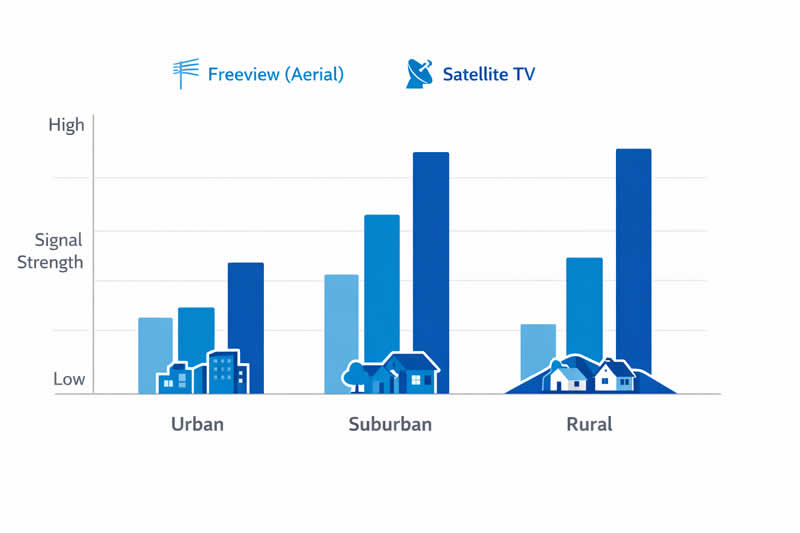
You don’t choose between Satellite TV and Freeview based on features alone. You choose based on your environment.
That’s where most people go wrong.
Freeview depends on a signal coming from a local transmitter. If you live in a strong signal area, it works well. If you don’t, it becomes frustrating fast.
Satellite TV works differently. It pulls signal from satellites in orbit. That means your location matters less, but your setup matters more.
If your aerial struggles now, switching to Freeview won’t fix anything. If your dish has a clear line of sight, satellite tends to stay consistent.
So before you even think about channels or cost, the real question is simple.
What works reliably where you live?
What Actually Happens in Real Homes
You’ll often see two completely different experiences depending on the setup.
In one home, Freeview works perfectly. Clear picture. Stable signal. No interruptions. It feels effortless.
In another, the same setup struggles. Channels disappear. Pixelation shows up. Weather makes it worse.
Satellite setups tend to feel more stable day to day, especially in rural or weak signal areas. But they can still drop during heavy storms or poor dish alignment.
What you end up with is not just about the system itself. It’s about how it interacts with your property, your surroundings, and your equipment.
That’s why two people can give completely opposite opinions on the same service.
How Freeview Actually Works
Freeview uses a standard TV aerial to receive digital signals broadcast from land-based transmitters.
It’s simple. It’s accessible. It’s already built into most modern TVs.
You plug in your aerial, scan channels, and you’re ready.
You typically get around 70 standard channels and a selection of HD ones. That includes BBC, ITV, Channel 4, Channel 5, and a range of smaller networks.
There are no monthly fees. Once it’s installed, that’s it.
But the strength of Freeview depends on signal coverage in your area.
If your signal is strong, it feels seamless. If it’s weak, it becomes unreliable.
How Satellite TV Works
Satellite TV uses a dish mounted on your property to receive signals from satellites in space.
Instead of relying on local transmitters, it pulls signal from above.
That means wider coverage. Stronger consistency in remote areas. And access to more channels depending on your setup.
You’ll often see this through Freesat or subscription services like Sky.
Freesat gives you free access to over 150 channels, including many in HD. No ongoing cost, just installation.
Satellite tends to deliver a more stable experience where aerial signals struggle.
But it requires correct alignment. A poorly positioned dish can cause just as many problems as a weak aerial.
The Difference Between Limited and Flexible Viewing
Freeview gives you a solid base. It covers the essentials. News, entertainment, daytime TV, and some extras.
Satellite opens things up further.
You get more niche channels. More HD content. Better coverage of regional variations. And often better access to on-demand services depending on your box.
If you’re someone who watches casually, Freeview usually feels enough.
If you want more choice, more flexibility, and more consistent access, satellite starts to stand out.
Satellite TV vs Freeview Pros and Cons
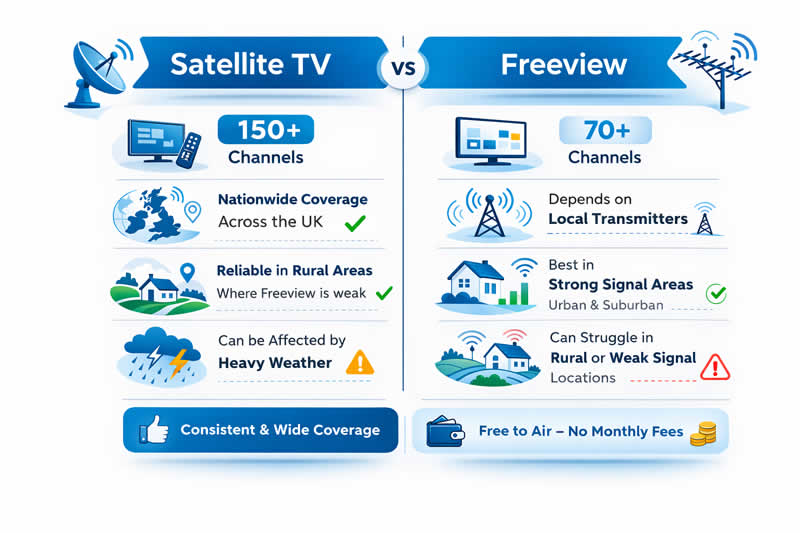
When you put both side by side, the differences become clearer.
Freeview Pros
- No monthly cost once installed
- Simple setup using existing aerial
- Built into most TVs
- Good channel selection for everyday viewing
Freeview Cons
- Signal depends on location
- Can struggle in rural or obstructed areas
- Fewer channels than satellite
- Weather and interference can affect quality
Satellite TV Pros
- Strong coverage across most of the UK
- More channels available
- Better performance in weak signal areas
- Consistent viewing in rural locations
Satellite TV Cons
- Requires dish installation
- Can be affected by heavy weather
- Setup needs correct alignment
- Subscription services can add cost
Which One Is Right For You
This comes down to how you use your TV and where you live.
If you live in a strong signal area and you only want standard channels, Freeview does the job.
If your signal has always been unreliable, or you want more variety, satellite becomes the better choice.
You’re not just choosing between two services. You’re choosing between consistency and simplicity.
Common Problems You Might Already Be Facing
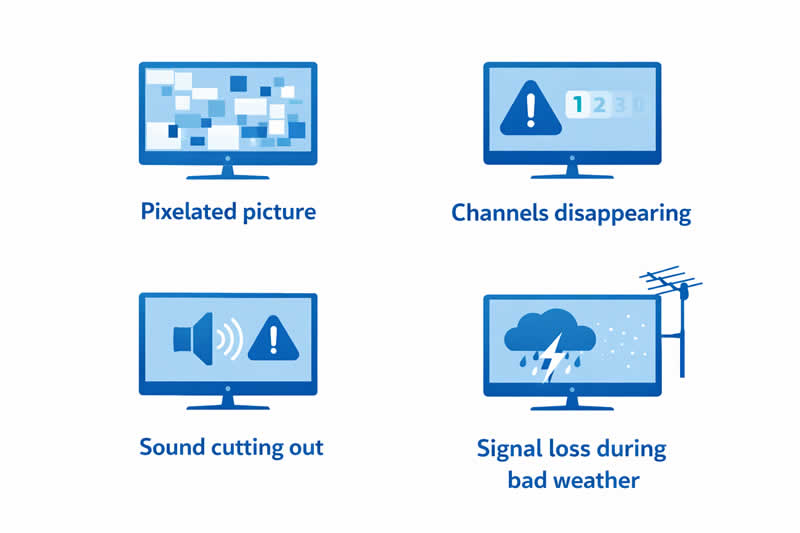
You might already be dealing with issues without realising the cause.
- Channels disappearing at random
- Picture breaking into blocks
- Sound dropping out
- Signal loss during bad weather
These problems often point to signal weakness or poor setup.
Freeview struggles when aerial signal is weak.
Satellite struggles when alignment is off or the dish is obstructed.
Knowing which system you’re using helps you understand why it’s happening.
What Most People Get Wrong
Most people assume more channels means better.
It doesn’t.
If your signal is poor, even 200 channels won’t help.
What matters is stability.
A smaller set of channels that work properly will always feel better than a larger set that constantly drops out.
That’s why choosing the right system matters more than choosing the one with the biggest list.
What Professionals Know That Most Don’t
There’s one thing professionals always look at first.
Signal path.
For Freeview, it’s about how clear the route is from transmitter to aerial.
For satellite, it’s about line of sight from dish to sky.
Obstructions like trees, buildings, or even roof angles can affect both.
That’s why a quick installation doesn’t always give the best result.
Small adjustments can make a huge difference to performance.
Before and After Setup Differences
Before proper setup, you might notice:
- Inconsistent channel access
- Poor picture quality
- Frequent signal loss
After correct installation, everything changes.
- Channels stay stable
- Picture becomes sharp
- Viewing feels effortless
The system itself doesn’t change. The setup does.
What To Do Next Based On Your Situation
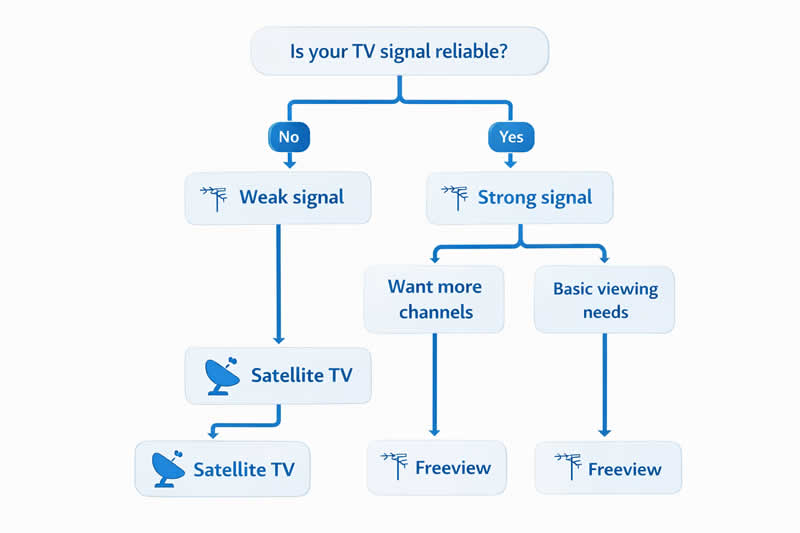
If your Freeview signal works well, you might not need to change anything.
If you’re dealing with ongoing issues, switching to satellite could solve it.
If you already have a dish but still have problems, it’s likely alignment or cabling.
If you’re unsure, the best step is to assess your current signal strength and reliability.
That tells you more than any comparison ever will.
The Part That Actually Matters
You don’t want more options. You want fewer problems.
That’s the real goal.
Whether that comes from Freeview or Satellite TV depends entirely on your setup.
The better option is the one that works consistently in your home, not the one that sounds better on paper.
Final Thoughts
Satellite TV vs Freeview is not about which one is universally better. It’s about which one works better for you.
If you want simplicity and you have a strong signal, Freeview makes sense.
If you want reliability in difficult areas or more choice, satellite stands out.
Once you match the system to your environment, everything becomes easier.
Clear picture. Stable channels. Less frustration.
That’s what you’re really choosing.